When we think of Resident Evil, certain images immediately come to mind: zombies, Lickers, Nemesis, grotesque creatures—and, of course, the towering Lady Dimitrescu. But when it comes to the franchise’s live-action film adaptations, the memories are considerably less fond.
The Resident Evil movies starring Milla Jovovich have, at best, been a mixed bag. For me, the only film that truly stands out is the one that started it all back in 2002. So when Zach Cregger—the director behind 2022’s Barbarian and 2025’s Weapons—was announced as the director of a new Resident Evil, my reaction was simple: finally. Maybe this would be the adaptation fans had been waiting for. Unfortunately, that excitement didn’t last very long.
Cregger’s Resident Evil doesn’t take place in the familiar mansion filled with zombies, nor does it revolve around giant snakes, spiders, or the established characters fans have come to know. It isn’t primarily centered on Raccoon City as we traditionally understand it, either.
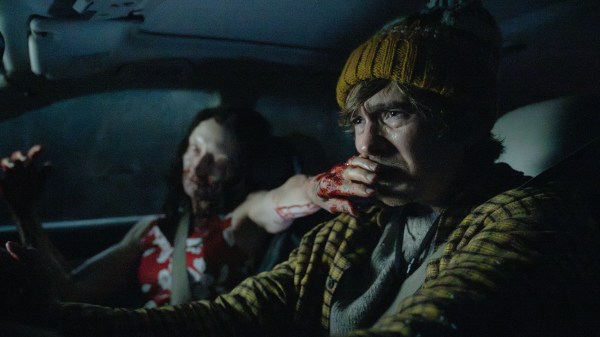
Instead, the film follows Bryan, a medical courier who, desperate for extra money, accepts a late-night, high-priority delivery to Raccoon City General Hospital. His routine delivery quickly becomes a nightmare.
While driving toward the hospital, Bryan hits a woman wandering along the dark road. When he discovers that she appears to be infected with what we can assume is the T-virus, his instincts as a good Samaritan kick in. Rather than leaving her behind, he puts her in his car and decides to take her to the hospital.
That decision transforms an ordinary night into a fight for survival. Soon, Bryan finds himself pursued by a bizarre creature composed of human limbs, hordes of zombies, and even a dog capable of shooting tentacles from its mouth.
On paper, there is plenty here that could have worked. Unfortunately, the film struggles to decide exactly what it wants to be.
The biggest problem with Resident Evil is that it feels like a movie with too many chefs in the kitchen. There are so many ideas competing for attention that the film eventually loses sight of the one thing it desperately needs: a consistent identity.
That isn’t necessarily a criticism of Zach Cregger’s talent as a filmmaker. Barbarian and Weapons demonstrate that he understands horror and knows how to build tension. But Resident Evil feels like a project that was simply too large for his particular strengths, and that disconnect becomes increasingly apparent as the film progresses.
The first half comes closest to delivering the Resident Evil experience I was hoping for. There are moments—particularly when Bryan arrives at a house searching for help for the injured woman—where the atmosphere genuinely feels like Resident Evil. The tension, the isolation, and the threat lurking just outside the frame all work together.
Then the movie takes a sharp turn. What began as horror gradually morphs into broad comedy, and unfortunately, much of that comedy doesn’t land.
At times, it feels less like a horror film and more like an Saturday Night Live sketch that somehow wandered onto the set of a survival-horror movie. And not one of the good sketches.
Austin Abrams, who many viewers may recognize from Weapons, plays Bryan, but I found him difficult to connect with as the film’s protagonist. Much of that comes down to his characterization.
Bryan spends a considerable amount of the movie screaming whenever he encounters one of the film’s creatures or zombies. Rather than making his fear feel relatable, the constant high-pitched reactions eventually become irritating. More importantly, Bryan simply isn’t a particularly likable character.
The film attempts to give him an additional emotional storyline through his relationship with his pregnant girlfriend. Before his disastrous night begins, we learn that she has recently discovered that she is pregnant and that Bryan doesn’t want the baby. The problem is that this storyline never develops into anything meaningful.
His relationship is introduced as though it will eventually become an important part of his character arc, but it ultimately feels tacked on. We never even meet his girlfriend, and the film leaves us wondering whether she survived the events of the night.
Rather than making Bryan more relatable, the subplot only makes his character more difficult to sympathize with.
There are obvious influences throughout Resident Evil. At times, the film feels like a strange combination of John Carpenter’s The Thing and Chuck Russell’s The Blob, with a little Resident Evil seasoning thrown into the mix. The problem is that the Resident Evil flavor never becomes the dominant ingredient.
Fans of the games may recognize some of the Easter eggs scattered throughout the film, and I’m sure there will be viewers who catch those references and quietly celebrate them from their seats. But Easter eggs aren’t a substitute for a good movie.
Recognizing something from the games might produce a moment of excitement, but those moments can’t carry an entire film. And that’s where this adaptation ultimately falls short. The Games Already Had the Recipe
What I find most frustrating is that the blueprint already exists. The Resident Evil games have repeatedly demonstrated what makes this franchise work. The ingredients aren’t a mystery. The games have successfully balanced horror, action, grotesque creatures, atmosphere, tension, and just enough absurdity to make the world distinctive. Yet every time Hollywood returns to the property, filmmakers seem determined to reinvent the recipe.
It’s like having Gordon Ramsay standing in the kitchen while a group of line cooks tries to teach him how to make Beef Wellington in a microwave. That’s essentially what this movie feels like. The filmmakers have access to decades of material that fans already love, yet the film seems determined to wander away from what made the source materialis successful in the first place.
Ladies and gentlemen, if you’re walking into Resident Evil hoping that this will finally be the live-action adaptation that brings the video game franchise to the big screen in all its glory, you’re likely to leave disappointed.
The film has moments where you can see the potential. There are creatures, horror elements, game references, and sequences that briefly remind you why the Resident Evil name carries so much weight.
But those moments are buried beneath an inconsistent tone, an unlikable protagonist, unnecessary story elements, and a screenplay that seems unsure whether it wants to be terrifying, funny, bizarre, or all three at once.
If you already understand that this version of Resident Evil exists in something resembling a parallel universe within the franchise and you’re simply looking for some wild, Sam Raimi-style horror fun, you may still find things to appreciate. But that’s not what I was looking for.
Resident Evil remains a powerhouse as a video-game franchise. Unfortunately, its live-action movie adaptations continue to struggle with the same problem they’ve had for years: Hollywood keeps looking for a new recipe when the franchise already gave them one.
And until someone finally follows that recipe, the live-action Resident Evil films may continue sitting alongside other failed video-game adaptations in Hollywood’s graveyard.